What is Trigonometry?
Trigonometry is the branch of mathematics that deals with triangles, circles, oscillations and waves; it is absolutely crucial to much of geometry and physics.
You will often hear it described as if it was all about triangles, but it is a lot more interesting than that. For one thing, it works with all angles, not just triangles. For another, it describes the behaviour of waves and resonance, which are at the root of how matter works at the most fundamental level. They are behind how sound and light move, and there are reasons to suspect they are involved in our perception of beauty and other facets of how our minds work – so trigonometry turns out to be fundamental to pretty much everything.
Any time you want to figure out anything to do with angles, or turning, or swinging, there’s trigonometry involved.
The first thing to understand with trigonometry is why the mathematics of right-angled triangles should also be the mathematics of circles. Picture a line which can turn around one of its ends, like a hand of a clock. Obviously, the moving end of the line traces out a circle – it’s like drawing with a compass. Now, consider how far this point is to the right or left of the centre point (we call this distance x), and how far above or below (which we’ll call y). By attaching horizontal and vertical lines of lengths x and y to the ends of the first line we get a right-angled triangle, like this:
(if you don’t see an interactive widget below, click this link to open it)
Drag the little circle around to get more of a feeling for this.
To put this in mathematical terms, the position (x, y) of a point at an angle of θ around a circle of radius r is related to θ and r in exactly the same way that the lengths of the adjacent (x) and opposite (y) sides of a right-angled triangle are related to the length of the hypotenuse r and the angle θ.
Sine and Cosine
This relationship is expressed by the two most fundamental equations of trigonometry:
x = r cos θ
y = r sin θ
Or, equivalently:
So sin (sine) is the ratio of the vertical side (the side opposite the corner we’re looking at) to the hypotenuse.
Cos (cosine) is likewise the ratio of the horizontal side (the side adjacent to that corner) to the hypotenuse.
Sine and cosine are functions, which is to say that they take one number (an angle in this case, usually expressed in degrees or radians) and spit out another. For certain values of θ, it is easy to figure out what the sine and cosine values are going to be just by thinking about what the angle corresponds to on the circle; the simplest cases are for θ = 0°, which is a line pointing right, giving cos θ = 1 and sine θ = 0; a line pointing straight up (ie. θ = 90°), which gives us cos θ = 0 and sine θ = 1, and so on.
At 45° the opposite and adjacent sides are the same length, so from Pythagoras’ Theorem
x2 and y2 must both be equal to ½, so
For values in between, the sine and cosine vary in a smooth curve, so that a plot of sin x against x is your basic wavy line:
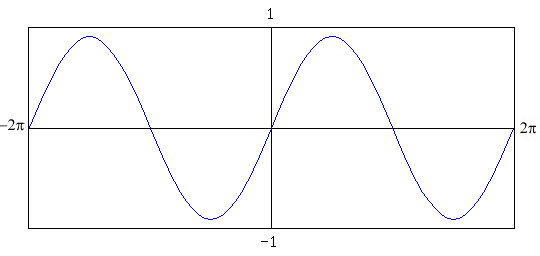
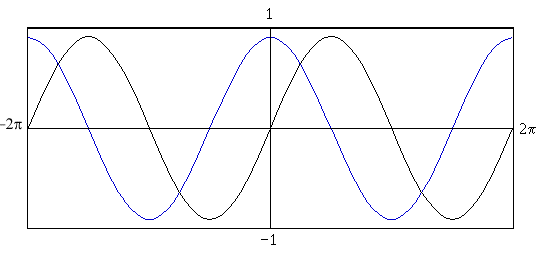
Cosine is to sine as horizontal is to vertical, so the graph of cosine is just like the graph of sine shifted by one quarter-turn. On a graph together, they look like this:
Tangent
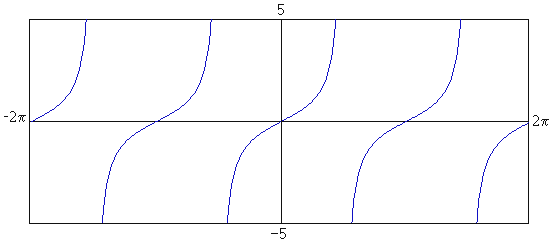
The third basic trigonometric function is called the tangent (tan for short), and it is defined as the ratio of the opposite and adjacent sides – that is:
Its graph looks like this:
SOH! CAH! TOA!
So, to recap – the three main trig functions express the ratios of the sides of triangles like this:
sin θ = opposite / hypotenuse
cos θ = adjacent / hypotenuse
tan θ = opposite / adjacent
(/ here is standing in for the horizontal line used in the formulae above, which works just like the line in a fraction: it means ‘divided by’)
Inverse Functions and Reciprocals
If you want to get an angle from two lengths – or, equivalently, the length of an arc drawn, you need the inverse functions of sine, cosine and tangent, which are known as arc sine, arc cosine and arc tangent respectively. You may see these written in the form asin, arcsin or sin-1. Computers can calculate an angle from two numbers without having to faff around, but as a legacy from the days before computers the functions conventionally take a single number, which is the ratio of the two sides relating to the function you need to use, as in the list above.
For example, in a computer you could input the lengths of the opposite side and the hypotenuse into the arc sine function to determine an angle. Using a calculator, you would need to divide the opposite length by the hypotenuse, and then apply arcsin to the result. This will give you the angle relative to the quadrant that you’re in, so that you may have to add one, two or three quarters of a turn to this number, depending on which of the lengths are negative, if any.
There are three more trigonometric ratios to consider – the reciprocals of the three basic ones, which is to say the ratios swapped round. The reciprocal of something is simply one divided by that thing, so for instance the reciprocal of 2 is 1/2, the reciprocal of 4/3 is 3/4, and the reciprocal of 3/4 is 4/3. The trigonometric reciprocals are mainly useful for simplifying integration and trigonometric identities. They are known as cosecant (cosec), secant (sec) and cotangent (cot), and are defined like this:
More Triangles
So far, I have only talked about trigonometry as it concerns right-angled triangles and circles. But trigonometry takes in the study of all kinds of triangles – be they equilateral, isosceles or scalene. Equilateral triangles just have three sides the same length, and three 60° corners. Isosceles triangles have two sides the same length and hence two identical angles, so it’s easy to split them down the middle and treat them as two identical right-angled triangles back to back. Scalene triangles, on the other hand, have every side and angle different, so if you ever have to calculate their lengths and angles you’re likely to want to use the the Sine Rule and the Cosine Rule (unless they happen to be right-angled scalene triangles, which obviously makes things easier). With three different angles to work with, it’s easiest to call them A, B and C, and call the lengths of the sides opposite them a, b c. The Sine Rule can then be written
Any equation remains true if you do exactly the same thing to both sides, so we can flip these upside down to get another form of the rule:
The sine rule is useful, for instance, if you know two angles and the length of one side of a triangle, and you need to find the length of another side; or if you know the lengths of two sides and one angle (which is not the angle between those sides), and you need to find one or more other angles.
In cases where you have two sides and the angle between them, or you are given all three lengths and asked to calculate angles, you will need to switch to the Cosine Rule, which can be written in two main ways:
or
The general formula for finding the area of a triangle is
area = ½ × base × height
Which is also equal to
The choice of which angle is which in all of these equations is of course completely abritrary, so feel free to swap around a, b and c at will, as long as you also swap A, B and C to make them fit.
Slopes and Oscillations
Look again at the graphs for sine and cosine; notice that when one is at an extreme of position, the other is at an extreme of slope; this observation is important for several reasons. The slope of the sine curve at any point (which is to say the rate of change of x with respect to θ) is in fact equal to the height of cosine at that point, if the angle is measured in radians – this is one of the reasons mathematicians like radians. Similarly, the slope of the cosine curve at any point is negatively proportional to the sine.
This means, if you stop to think about it, that the rate of change of the rate of change at any point (the second differential of a sine or cosine curve, to use the mathematical term) is always in negative proportion to its height at that point; it is as if it was being pushed towards the origin by a force proportional to its distance from it. In fact, in real life when something is pushed towards a central point in proportion to its distance from that point (as in pendulums, weights on springs, molecules trapped in solids, and musical instruments – we call this ‘simple harmonic motion‘) it will indeed move in a sine curve, which is why trigonometry is the mathematics of oscillations as well as triangles and circles.
The force on a body in these cases is equal to –k × x where k is a constant depending on the system in question (the spring constant in the case of spring systems) and x is the distance from the equilibrium point; the position of the body at any moment in time is given by
where t is time, ω is the angular frequency of the motion, which is equal to k2, and A is the amplitude of the motion.
Waves
A wave is an oscillation which moves in space, such as sound waves, earthquake waves and the matter waves and light waves which turn out to make up just about everything in the universe. Sine waves turn up all over the place; more complex waveforms can always be broken down into a series of superimposed sine waves of various frequencies, in a process known as a Fourier transform. Sub-atomic ‘particles’ are best thought of as wave packets.
This extremely general applicability of the idea of sine waves results in trigonometric functions turning up everywhere you look in physics. The most general form of the basic wave equation, appearing everywhere from classical mechanics through electromagnetism to quantum physics, is this:
where λ is the wavelength (the distance between one peak of the wave and the next) and d is the distance along the wave. A full exposition of the mathematics of waves is beyond the scope of this writeup; I will just mention quickly that a fuller understanding of it requires a grasp of the idea of superposition and interference – what happens when waves meet each other; refraction – what happens when a wave passes from one medium to another; and diffraction – what happens when a wave passes through a hole. Standing waves and resonance are also profoundly important almost everywhere that waves turn up; they account for the sounds made by different objects, the energies of photon emitted by different atoms and molecules, and for a staggeringly wide range of other phenomena.
Infinite Expansions
Interestingly enough, the sine and cosine values of an angle can be found from the following infinite series, should you ever need to calculate them from scratch:
The first interesting thing to notice about these series is that sin θ gets closer and closer to θ as θ gets smaller. This means that θ turns out to be a very useful approximation for sin θ at small angles – in fact, the force pulling a pendulum towards its equilibrium point is proportional to the sine of its distance from the centre, not directly to the distance, but it makes remarkably little difference as long as you don’t swing the pendulum too far.
Another interesting thing about the infinite series for the trig functions is how similar they are to the infinite expansions of the powers of e, which is an irrational number equal to around 2.718. You see, the infinite series for eθ looks like this:
It is immediately obvious that the form of the equation is similar. To show us best just how similar it really is, we need to bring in imaginary numbers. What we can do is multiply θ by i in the expansion (i is – loosely speaking – the square root of minus one; so i × i = -1). This gives us the expansion for eiθ:
…Which, if you look at it, happens to be equal to cos θ + i × sin θ. This shows clearly the surprising, but unmistakably logical connection between the complex numbers and trigonometry, including such gems as Euler’s Identity, the equation linking what may be the five most important numbers in mathematics:
eiπ + 1 = 0
This connection between the expansions of ex and the trigonometric functions also brings out the relationship between trig functions and their kin the hyperbolic functions, hyperbolic cosine (cosh) and hyperbolic sine (sinh), which – despite their names – otherwise appear quite different.
So…
I hope I have explained, at least in outline, all the most important things about trigonometry, and made it clear why I think anyone should care. If any of this seems unclear, I hope the links will help to fill in any gaps; otherwise, I can be reached by email. There is much more that I could be saying about the applications of these functions – besides its basic role in geometry and ubiquitous use in physics, they turn up all over the place in computer graphics, in lighting, curves and in strange effects like the Curlicue fractal.
I think that best ways to understand trigonometry are to play around with sine and cosine or to work with them. I encourage you to try making simple pictures or animations by either chucking together trig functions to see what they do, or taking someone else’s code and messing around with it. The range of possible effects is limitless, with beautiful permutations at almost every turn. You might like to try my gentle introduction to programming, using Processing.
I’m very interested in any feedback on this page – how and why did you find it? Have you found it helpful in learning, or teaching about trigonometry? If so, was this is in a formal or informal context? And do you have any suggestions for improvements?
See also:
- My trig-based mathematical stills
- The Geometry Junkyard has many more fun things to do with trig
References:
- Mannall, G. and Kenwood, M. (1995) ‘Heinemann Modular Mathematics for London AS and A-Level (P2)’. Oxford, Heinemann Educational Publishers
- Stephenson, G. (1995) ‘Mathematical Methods for Science Students’. Harlow, Longman Scientific & Technical